
Research, needs analysis, planning, getting inspired, discussing the challenges and imagining possible solutions is all fine, but we don’t really understand and grasp the true nature of things until we start to design and develop real life solutions. The second diamond is where the action starts, when the project is kicked off, after being approved and funded. We pick up where the project brief and/or application left, by turning the plan into actual activities, based on estimated plans and budgets. This is by no means a simple implementation process. It is rather a continuation of the development work, but this time with the resources and time to make things happen. Ideas have to be brought into life. Solutions, products and services should be developed, tested, altered and finally delivered or implemented throughout the “Develop” and “Delivery” phases.
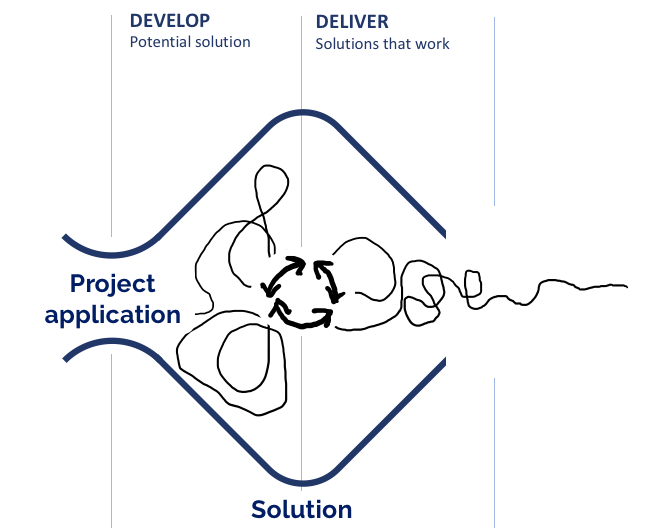
DEVELOP: The third phase of the double diamond is the second divergent process of exploring and developing actual solutions to the projects task, outlined in the project brief and/or project application. This is the time where the ideas and concepts imagined in the previous stages are developed into solutions or concepts that are prototyped, tested and iterated in a process of trial and error – a process that is at the core of human creativity, and since our childhood this process has been crucial in order for us to move beyond the known.
This is the part of the project where you need to muster confidence in creativity and an innovative spirit. The more innovative the project needs to be, the less this process is about the logical and deductive “solving” of problems, and more about an open-ended, open-minded, and iterative process[1]of exploration and “working through” the problems in order to find valuable solutions, as described by Marty Neumeier[2].
This includes non-logical processes or intuition as argued by OECD in their take on Core Skills for public sector innovation[3]. The more complex and wicked the problem is, with no “definitive definition” possible, the more we have to rely on testing and intuition as described by OECD. While intuitions might be “…an uncomfortable topic for many disciplines because of its apparent lack of seriousness, is in actuality a critical skill honed by experience and central to many designers’ practice. In the context of strategy, intuition requires full investment of time and thought, so as to acquire a sense about how things fit together.” “Also testing is dependent on intuition to the extent that it requires experience to know how to test ideas efficiently and productively.”[4]
Non-logical processes, experimentations, playfullness and relying on the tacit knowledge of your intuition are at the core of creativity and creative confidence. Creativity is by nature wild and untamed and should not be hampered by a manage and control focused mindset. That would only obstruct the process and cause a mediocre outcome, as this will rule out random inspiration, wild ideas and playful “what if” experiments. The key is to act and to makethings outside the comfort zone of what you think you know.
DELIVERY
The last part of the development work is a convergent process where we synthesise and conclude on the experiments and the knowledge gathered in development works. This is the time for making choices and deciding what matters most, what solutions to go with and to turn prototypes into functioning solutions, that are taken through the last circles of testing and finalized. As discussed earlier this is not a linear process, but it might very well involve several loops between the divergent and convergent processes of the develop and delivery phases.
Balancing constraints. This convergent process of making choices and deciding which solution to go with, involves balancing conflicting interests and aspects and working with constraints. Following the tradition of designers like Charles and Ray Eames, people working around IDEO and d.school emphasize that the ability to recognize the constraints of the project, and willingness and enthusiasm for working within these is at the core of design-driven innovation.
This can be seen as balancing three sets of constraints or factors. Firstly, being human centred, the point of departure is empathizing with users and understanding their hopes, fears, and needs and uncover what’s desirableand what solutions would probably appeal to the users. Secondly, this has to be balanced with technical, organisational, legal, time, etc. constraints, in order to determine what is actually feasibleto implement, and thirdly, what is financially viable. Together these three factors have to be balanced to hit the sweet spot, where what is desirable for people, what we believe is feasible to do and what could be a viable and sustainable solution for our problem come together and form valuable and sustainable solutions.
Disseminate. When you feel that this is it, the product or service is launched. In many projects “launching” also means dissemination or in other words sharing your findings and results in order to maximise the value and outreach of the project. This is not only a question of publishing your results, hosting a conference and setting up a website. Rather than a “communicative” approach, a much stronger approach to dissemination would be one that takes an interactive and collaborative approach. Thus, a good consortium embedded in a relevant professional network, collaborating to put the innovations of the project into good use is crucial for leveraging the value of the project.
[1]Brown, Tim, Change by design: how design thinking transforms organizations and inspires innovation, HarperCollins Publishers, New York 2009, p.17
[2]Neumeier, Marty, The Designful Comapany, New Riders, Berkeley 2009, p.50
[3]OECD, Core skills for public sector innovation, A beta model of skills to promote and enable innovation in public sector organisations, 2017
[4]Opcit p. 50

 Jens Boegetoft
1 Comment