
Continuous globalization, new tech developments, turbulent geopolitics, cyber threats, troubling migration, demographic shifts and devastating climate changes etc. are putting our lives, businesses and societies under pressure. All over Europe we are working on NEXT GENERATION free and fair society that can combine global competitiveness with social cohesion and sustainability. Governments, local communities, schools, the healthcare sector, universities, citizens and businesses across Europe are working with these challenges, and increasingly we are working together to inspire each other and pool resources and knowledge in order to create solutions and new possibilities.
These are complex challenges that call for both creativity and high levels of knowledge and innovative capabilities. We are increasingly experimenting with new methods for fostering innovation and more human centered solutions in order to increase the real-world value of the projects. However, these methods and models are not designed to cater for EU projects or other externally funded projects, not to speak of international cross-cultural projects, interpretation of calls, the drawing up of applications, partner search and international collaboration, etc. This of course makes them less inspiring and less suitable for use in these projects.
The mindsets of creativity and innovation
Thus, to make the most of the many projects we develop each year, designing a model specifically for this kind of innovative project might therefore prove useful in the development of better and more valuable projects. I have therefore designed a framework for the development of innovative projects, especially EU projects, building on the works of for example Design for Europe, IDEO, Nesta, OECD and The British Council, as well as a number of scholars and practitioners, including Stappers and Sanders, Tom Kelley, Tim Brown, Neumeier, et.al. The framework is not meant to act as a rigid procedure, but in the spirit of these references, more as a reminder of all the aspects of a good project and as an approach to combine creativity, a sound knowledge base and thorough analysis in a coherent way.
Before diving into frameworks, let’s get off on the right foot. The great thing about working with creativity and design-driven innovation is that it is basically an optimistic approach to life, confident that new, better things are possible and that you, I and we can make them happen. We can make a difference, solve problems and improve our lives by unleashing our creativity, analytical capability, all our knowledge and experience and trust our instincts and dream up brilliant solutions. Then act, fail, try again, change it, try again and make it come true.
“Creative confidence is the notion that you have big ideas,
and that you have the ability to act on them.”
David Kelley[1]
This optimistic, persistent and experimenting approach is the red threat in an innovative approach driven by a creative mindset with an equally strong ability to analyse and to see patterns and correlations. Without this kind of optimism and the mindsets of creativity and innovation, the framework is merely an empty shell. Perhaps you might want to take a closer look at the mindsets of creativity and innovation here:
MINDSET OF CREATIVITY AND INNOVATION
A framework for innovation projects
The framework is created by merging two well-known representations of the design-driven innovation process, having more or less the same flow, but emphasizing different aspects of the process.
The first model is the double diamond model by The British Design Council – see figure 1. The main feature of the Double Diamond is that it organizes the development work into a “divergent” and a “convergent” phase and divides these phases into a four-stage model of Discover, Define, Develop and Deliver. In the first diamond the preliminary investigation of the problem is done, and a problem definition is developed and formulated in a project/design brief. In the second diamond a solution for the problem is further explored in detail and a solution for the problem is found. (Design Council[2]).
Figure 1: Double diamond
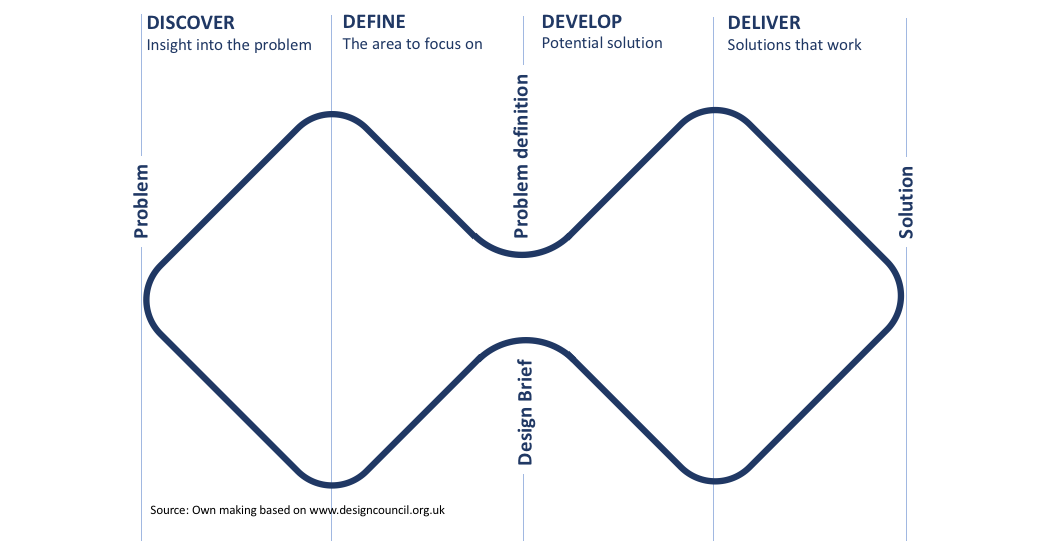
The double diamond with its two processes of respectively divergent thinking explore the problem and create choices) and convergent thinking make choices and solve the problem), fits pretty neatly into the process of the project application and the completion of for example an EU project. Thus, the first diamond would be the development of the project and the preparation of the project application. The second diamond will then represent the problem solving and completion of the project, ending with the dissemination of the results. However, this model doesn’t say much about the important process leading to the project and the equally important post-project phase of utilising the outcome of the project. Furthermore, this model is rather sketchy and far from the reality of innovation projects. The double diamond has therefore been combined with insights from Sanders and Stappers (2014)[3]– see figure 2.
Figure 2. Phases along a timeline of the design process
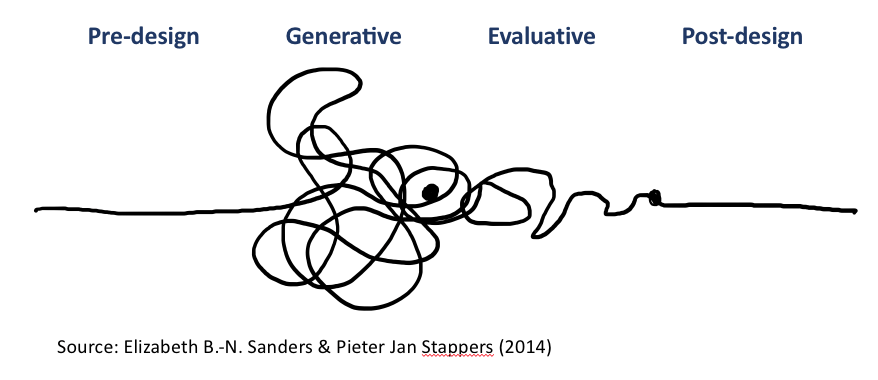
Here the design process is illustrated as a squiggly line showing the path that design takes over time while going through four phases along a timeline: Pre-design, generative, evaluative and post-design. The first dot in the graphics indicates the definition of the design opportunity (design brief) and the second dot represents the finished outcome of the process.
The generative part of the model corresponds with the explorative nature of the divergent phase, and the evaluative part with the convergent phase of the diamond framework. However, there are several insights to gain from the Sanders and Stappers model.
Firstly, the model draws our attention to the pre-design processes that here translates into a pre-project process. This is the crucial fuzzy process prior to the project where the ideas for the project are conceived, and the problems framed. Secondly, the model also includes the equally important continuous work that should follow after the project in a post-design / post project phase to ensure the sustainability of the project. For example, post-project research and development to ensure that the result, including deliverables, continuous to create value for stakeholders beyond the project period and funding. Thirdly, the squiggly line illustrates that creativity and innovation are iterative and non-linear processes, where solutions emerge from the fussy and sometimes chaotic process of discovery – including processes of trial and error, when we have to work our way towards discovering and fulfilling user needs or finding solutions for wicked problems.
Within the context of applications-based projects we go through this fuzzy front end process two times. The first time is when the project idea is conceived, and we seek inspiration and try to imagine how we might approach the challenges and work our way through them in order to find solutions. The ideas we get are written into the project application. The second time is after the project has been granted, and we carry out the project and actually work our way through the problems. The second time our search for solutions is limited, because the direction has already been set in the application. This flow of discovery and development is illustrated as two fuzzy processes in the project development model – see figure 3.
By merging the double diamond, the squiggly line model and the insights from hermeneutics, we get a framework consisting of 4 key elements of an innovation project. The fuzzy front, where we sense a problem or need or perhaps get inspired to develop new things and solutions. The first diamond is where the challenge is projectified and turned into a project application. The second diamond is where the project is carried out, resulting in the delivery of some kind of output and/or implementation of tested solutions. Finally, there is the post-project, where we evaluate and realize the long-term effects and continue the evolution and development of the original solution. The framework is illustrated in figure 3
Figure 3 Framework for Innovation projects
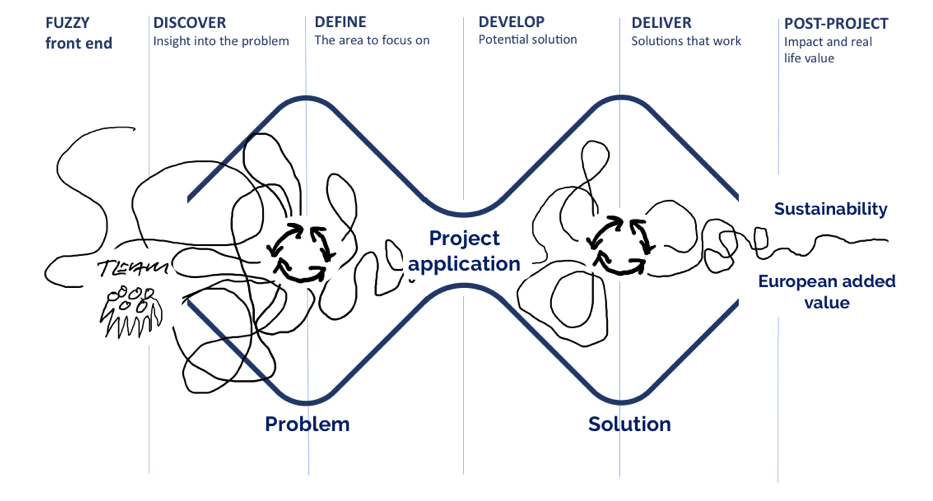
Explore each of these four sections with additional insights into creativity, analysis and innovation
FUSSY FRONT END
DEVELOPING THE PROJECT (The first diamond)
DOING THE PROJECT (The second diamond)
POST-PROJECT
[1]http://www.designkit.org/mindsets/3
[2]https://www.designcouncil.org.uk/news-opinion/design-process-what-double-diamond
[3]Elizabeth B.-N. Sanders & Pieter Jan Stappers (2014) Probes, toolkits and prototypes: three approaches to making in codesigning, CoDesign, 10:1, 5-14,

 Jens Boegetoft