
HUBs are fast becoming a worldwide phenomenon and the term “hub” is being used to describe a certain way of organising to foster creativity and innovation through interdisciplinarity and cooperation between independent actors across sectors. It is a dynamic way of bringing together diverse talents, disciplines and skills in order to intensify innovation beyond the scope of traditional organisations and project organising.
Often the term is linked to themes such as a new economy, entrepreneurship, creativity, innovation, new lifestyles, and social and cultural integration, trying to seize opportunities offered by emerging creative sectors, digital technologies and the sharing of a ‘maker’ economy.
But what exactly is a hub? The term “hub” seems to mean different things to different people and the common use of the concept does not differentiate between for example incubators, accelerators or labs[1] or between physical and virtual hubs. Even so, from all this dissimilarity we can extract and shape a meaningful and useful concept that can help us understand this emerging way of organising and use hubs as a way of organising for creativity, collaboration and innovation.
Four core features
As the word indicates, a hub constitutes a centre for activities creating proximity of actors with space for work, collaboration and development of cross organisational projects. This force of attraction could stem from four core features identified by Toivonen and Friederici[2]in an observation study of hubs and related collaborative organizations in Europe, East Asia, and Sub-Saharan Africa:
I. Hubs build collaborative communities with entrepreneurial individuals at the centre driving the development and function as (informal) leaders of the hub. Even so collaboration works on an egalitarian basis between autonomous actors creating a “genuine sense of community—a cozy social milieu”[3].
II. Hubs attract diverse members with heterogeneous knowledge. A central element in the dynamics of hubs emanates from an embracing and positive attitude towards diversity, not least professionally. This diversity is an important part of a collaborative mindset, seeking out unique and viable innovations and new solutions in the interaction across sectors, organizations and professions including for example freelancers, businesspeople, engineers, designers, civil servants and students. So-called T-shaped people play a pivotal role here in facilitating this kind of cooperation, with a combination of great professional skills and the ability to collaborate and to share knowledge across other disciplines.
III. Hubs facilitate creativity and collaboration in physical and digital space. Thus, often a hub involves a property element located in a community in which it supports activities between a variety of other local actors, including educational and public institutions, the private sector, civil society actors and private people.
The spaces are designed to help foster a collaborative and energetic and optimistic atmosphere of “we-can”, supporting face-to-face interactions and processes that foster creativity and co-creation including visualization and prototyping – this also includes digital spaces.
IV. Lastly, hubs seem to bring global cultures of for example entrepreneurship, innovation or social activism into the local community. In many ways professional cultures are increasingly global and people tap into professional communities and value systems driven by international discourse. Thus, not only does the hub foster interdisciplinarity and cooperation across sectors, it also fosters internationalisation and a wider global awareness.
Organising for turbulent times in need of new solutions
These distinctive features make hubs a way of organising that transcends not only traditional organisational boundaries, but also professions and sectors. At the core of organising the hub lies community building, networking and facilitating the coming together of diverse people in order to inspire and provoke new perspectives, questioning the things we take for granted, ignite new ideas and energize initiatives beyond our normal scope of activities.
Hubs have already proven to function well as hotbeds for innovative projects, new businesses and emerging talents, linking them to broader networks in the (local) economy, including business support and access to finance.[4]This way of organising could therefore prove useful in our efforts to solve some of the complex challenges and problems in business and society alike – a task that is hard to handle in traditional organisations.
Continuous globalization, overwhelming technological developments, turbulent geopolitics, troubling migration, demographic shifts and devastating climate changes, to mention just a few issues, are driving widespread changes to our society. Each of them is more than enough to pose a significant challenge and together all these issues are creating very complex challenges and wicked problems, resulting in not only an urgent need for innovation, but also a need for new ways of developing solutions and creating new possibilities.
To deal with these complex challenges, it is necessary to design and implement coherent systemic solutions that combine a wide range of initiatives, e.g. promotion of education, business development, social inclusion, infrastructure and environment. It is a task that involves balancing various interests and requires close collaboration across disciplines and collaboration across administrations, citizens, businesses, civil society and politicians.
By combining a purposefulness with the self-directed initiatives of communities the hub might indeed be a way to foster the necessary collaboration, international outreach and local involvement. At the same time the hub seems to bring different skills, professional competences, intensions, interests, resources and perspectives together. This creates a certain milieu and a culture of creative confidence, entrepreneurial spirit, adroitness and capability, that is vital for our ability to turn complex challenges into valuable possibilities and actions.
Different purposes, different hubs
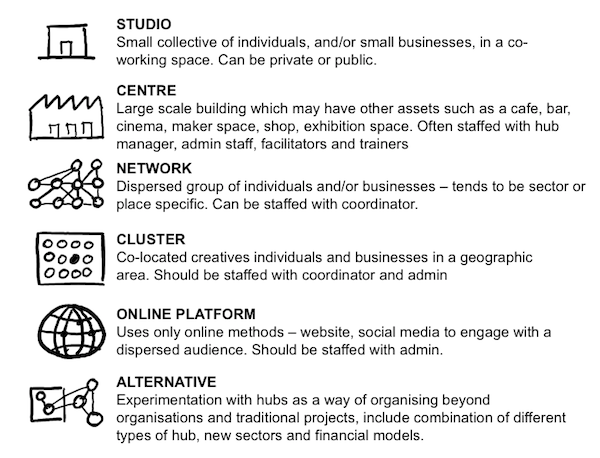
Hubs come in all different shapes and sizes and for sure there isn’t any “one size fits all” concept for a good hub, On the contrary, a hub should be bespoken to the particular purpose, challenges and context it needs to address. As a way of organising for creativity and innovation they are relevant in private and public sectors alike and in a wide range of sectors. As inspiration and starting point for the design of a bespoke hub for your specific purpose, let’s wrap up this discussion with six archetypes based on The British Council typology of first cut variants of creative hubs.[5]
[1]Dovey, Jon et. Al. (2016) Creative Hubs: Understanding the New Economy, British Council, The Creative Hubs Report 2016, p. 8
[2]https://ssir.org/articles/entry/time_to_define_what_a_hub_really_is
[3]Op. cit.
[4]Dovey, Jon et. Al. (2016) Creative Hubs: Understanding the New Economy, British Council, The Creative Hubs Report 2016, p.7
[5]British Council (2015) Creative Hub kit, https://creativeconomy.britishcouncil.org/media/uploads/files/Creative_HubKit.pdf

 Jens Boegetoft